
3 Questions for Districts Addressing the Role of Police in Schools
DRAFT FOR REVIEW ONLY
August 31, 2020
Policymakers, district and school leaders, community advocates, nonprofit organizations, teachers, families and students all want school to be a place that feels safe and welcoming for every student. But with the recent shootings and murders of Breonna Taylor, Ahmaud Arbery, George Floyd, Tony McDade, Jacob Blake, and countless other Black Americans at the hands of police, our country continues to grapple with its history of systemic racism and police brutality. This national reckoning is playing out in schools too. As communities grow their understanding of the impact of police presence in hallways and classrooms, particularly on Black students, there is mounting pressure on districts to cut ties with police departments in favor of investments some believe will help build the safe, welcoming, and supportive school climates that we all want.
The heightened scrutiny around these big-ticket investments comes at an inflection point for many districts. First, fewer students are attending in-person school this fall. On its own, this change warrants rethinking the size and nature of school safety investments. Second, state revenue forecasts suggest that upcoming budget cycles will be challenging, even with additional federal stimulus funding. This means every dollar must be invested strategically.Most districts have a vision for positive teaching and learning environments— now more than ever, the choices and investments they make in school safety can make or break their ability to make those visions a reality.
Every district needs to ensure that its safety-related vision, strategy, and investments are aligned with the experiences and outcomes it wants for students.A key component of this work might be shifting investmentsawayfrom school policing andtowardsevidence-based practices that facilitate safe, supportive school climates.
As a starting point, we offer three key questions to help district leaders reevaluate their school safety strategy:

Vision: What do we believe needs to be true of our schools in order to provide a safe and welcoming environment for all students and staff?

Strategy: In what ways do our current safety investments support or hinder this vision? How are students of color, particularly Black students, affected by our practices?

Resource Allocation: What resource shifts must we make to better align our investments with our vision for safe and welcoming schools? To foster safe school climates, which types of alternative investments are better aligned with research and with our district vision?
As districts across the country take on this important work, we at ERS are focused on building our own capacity. This means that we will be digging deeper to examine the different ways districts invest in school safety and the full breadth of impacts that police presence has on students and staff. Below, we share some of our preliminary findings on how districts invest in police and the outcomes of school policing on students.
SPENDING LEVELS AND APPROACHES VARY WIDELY ACROSS DISTICTS
Nationally, district security spending data lacks the detail needed to fully quantify school security investment or differentiate spending on school resource officers and sworn police officers from other security-related investments. We do know from national staffing data that 45% of schools have regular police presence. We also know these investments are relatively new – stemming from significant increases in spending in the decade following the Columbine shooting in 1999.
Our analysis of spending data across 15 large districts across the US reveals a wide array of spending levels and approaches. Spending levels range from 0.4% of total operating spend to as much as 3.2%.* Depending on the district, school safety expenses may include sworn police officers or school resource officers (SROs), private security guards, surveillance devices such as cameras, and monitoring equipment such as metal detectors. Given such a wide range in the amount and nature of this investment, one might expect wildly different safety outcomes. While ERS hasn’t conducted such a comparative analysis with this set of districts, we know anecdotally that perceptions of safety in schools don’t track with the differences in these investments – which we think suggests the need for deeper scrutiny.
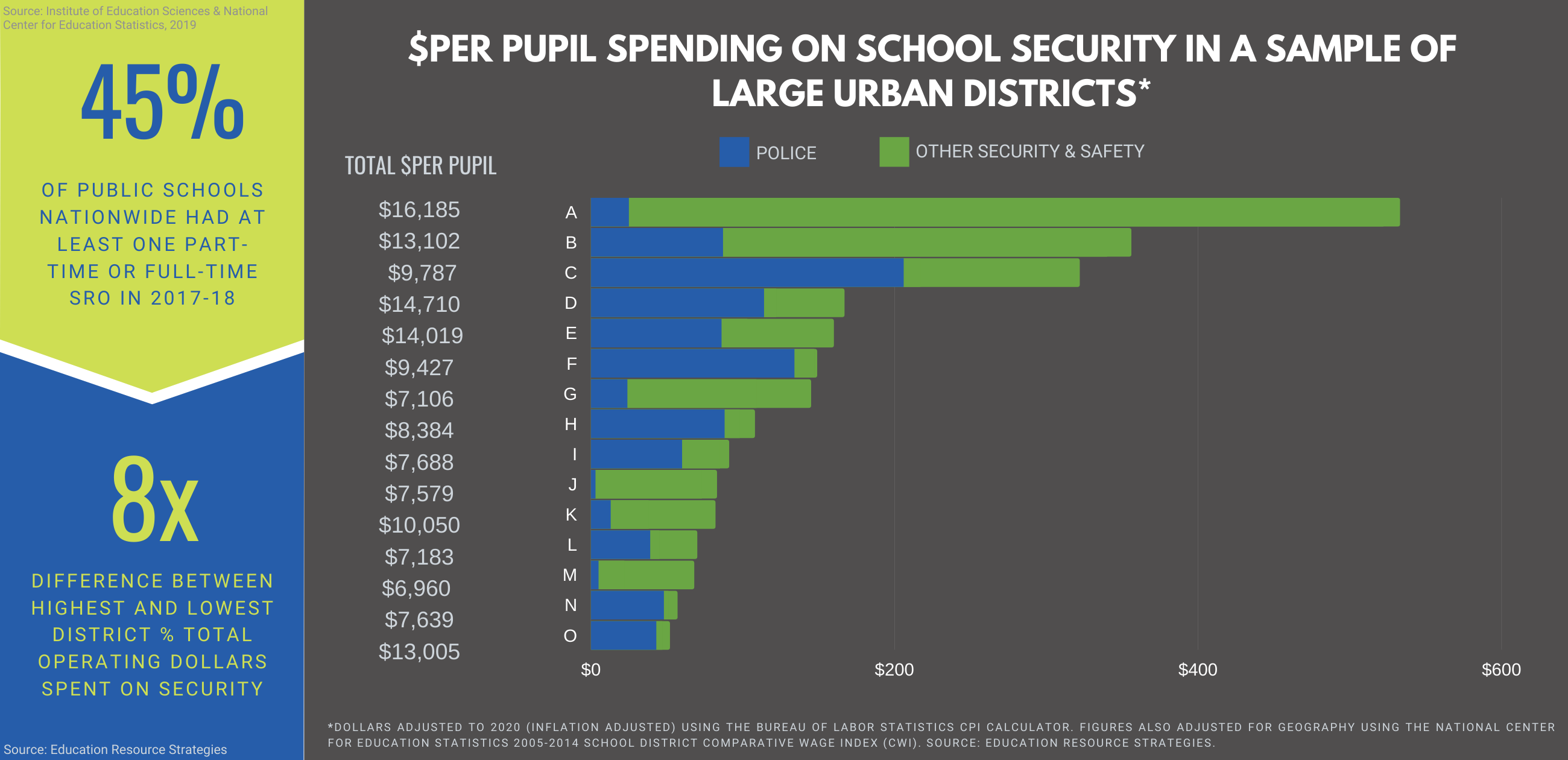
*From our direct work with districts, we know that in some cases, police presence in schools can come directly from the city or county’s police department – so the funding for school-based police sits outside the district’s budget. As such, total spending on officers may be higher in some districts than what is reflected here.
RESEARCH:Black students are disproportionately harmed by detrimental impacts of school policing
At the highest level, investments in policing and security ideally keep students and staff safe from each other and/or people from outside the school community. More research is needed to examine the full breadth of impacts of safety investments on students and staff.While we aren’t aware of formal research that shows the impact of school police on school shooting avoidance, we do know that school shootings have tragically occured despite their presence.
There is some evidence to show that investments in school policing are not meeting their intended safety outcomes and in fact are increasing academic and social emotional needs of Black students.2Disciplinary actions that result in arrest have lasting consequence and therefore must be avoided to the greatest extent possible.
We also know that Black students are both disproportionately disciplined for the same behavior and are more likely to be disciplined through law enforcement. Black boys are three times more likely to be arrested at school than their white classmates.3 Finally, we worry about Black students’ perceptions of their own safety. Given the recent visibility into so many police killings of Black men, we suspect Black students’ worries about their own safety may further increase when they are able to return to school.
If our intent as district leaders is to keep students safe and ready to learn – including and especially students of color – then we have an urgent obligation to look closely at the impact of our investment in school security. We must move away from school policing investments that interfere with learning and achievement and move toward strategic investments that create safe and welcoming schools for all students andnavigate racial equity implications.
Further Reading
Background on Current Practice and Challenges:
- What Do We Know About the Effects of School-Based Law Enforcement on School Safety?, WestEd
- Cops and No Counselors: How the Lack of School Mental Health Staff Is Harming Students, American Civil Liberties Union
Alternative Practices and Investments:
- “And they cared”: How to Create Better, Safer Learning Environments for Girls of Color, The Education Trust
- Now Is the Time to Remake Our Schools With Equity in Mind, Education Post
Citations
- Diliberti, M., Jackson, M., Correa, S., Padgett, Z., & Hansen, R.Crime, Violence, Discipline, and Safety in U.S. Public Schools: Findings From the School Survey on Crime and Safety: 2017–18. National Center for Education Statistics, 2019.https://nces.ed.gov/pubs2019/2019061.pdf
- James, N. & McCallion, G. School Resource Officers: Law Enforcement Officers in Schools. Congressional Research Services, 2013.https://fas.org/sgp/crs/misc/R43126.pdf
- Blad, E. & Harwin, A. Black Students More Likely to Be Arrested at School. Education Week, 2017.https://www.edweek.org/ew/articles/2017/01/25/black-students-more-likely-to-be-arrested.html?r=470919738
- Finn, J.D. & Servoss, T.J. Misbehavior, Suspensions, and Security Measures in High School: Racial/Ethnic and Gender Differences. Journal of Applied Research on Children, 2014.https://digitalcommons.library.tmc.edu/cgi/viewcontent.cgi?article=1211&context=childrenatrisk